
[Note: in between writing this essay and getting around to publishing it, the UK and Norway have signed a defence treaty that significantly deepens our cooperation on naval operations and procurement. This is in fact a small step in the direction of what I am arguing for here, so I was pleasantly surprised.]
The UK is in the doldrums at the moment. Domestically, despite creaking infrastructure, we seem unable to build anything; the healthcare system is crumbling due to decades of underinvestment, low pay and poor working conditions; and the government is unable to balance the budget, despite spiralling borrowing rates. This however has all been written about by other people at great length, and isn’t what I want to talk about right now. The UK is also in the doldrums internationally - we have no geopolitical strategy, no guiding principles and no vision. Some might view it as putting the cart before the horse, to discuss this before we’ve resolved our domestic issues, but I disagree. It is precisely because we no longer know who we are, that we can’t agree on how to fix any of the problems.
Before Brexit, we were comfortably trundling along as an integral part of the EU - balancing the power struggle between France and Germany while doggedly pulling the institutions of the EU in a liberal, pro-free-trade direction. This was a purpose and an identity that served us quite well, but a few decades of using the EU as a convenient punching bag/bogeyman to obscure the failures of our own government, managed to turn a majority of the populace thoroughly against the idea. In the referendum that followed, no single vision of the country’s future outside the EU was embraced, allowing Brexit to mean different things to different people, increasing the level of support beyond what any single vision might generate. Now, 8 years on from the invocation of Article 50, we are still without a coherent strategy for what role we want to play on the world stage.
So far, the main competing “visions” that are being offered are singularly uninspiring:
Singapore-on-Thames
An idea that appeals to a certain wealthy demographic, but the promise of a deregulated free-market utopia requires certain decisions to be made that would be extremely unpopular in most of the country, as they would likely result in even more concentration of resources in London, at the expense of every other region of the UK.
Making London an indispensable capital market would certainly keep us on the map, but allowing the rest of the UK to wither on the vine, as London hoovers up investment, talent and attention is electorally prohibitive.
Magically Resurrect the British Empire through sheer force of will
Not so much a strategic vision as a collective hallucination - the world has changed, and the things we would need to do to satisfy this lust for nostalgia range from difficult to distasteful to downright impossible.
Keeping our Head Down
Directly in opposition to the last one, “the UK had its time being an important country, now it’s time to accept that our empire is over, and let someone else have a turn” is a sentiment that I see quite a lot.
Although nostalgia for the empire is disturbing, this contrarian approach is incredibly self defeating. For all our past crimes, the UK was the force behind ending the slave trade, and has been a bastion of liberal values for over a century.
I doubt that the majority of people actually want the UK to diminish into obscurity, but it appears to have been the trajectory of the last 8 years.
Rejoining the EU
A supremely unpalatable proposition to many in the electorate, as this would mean admitting defeat. Going back to the EU, cap in hand, asking to rejoin would be the final nail in the coffin for the idea that we are an important country that can be relevant in the modern world in our own right.
It might be a good decision financially, but it is a pill that would be too difficult to swallow. Many would prefer to die trying to make Brexit work than face the humiliation of re-accession.
What other visions could there be? There are a great many ideas floating around out there, but from what I have seen (aside from increasingly inventive reframings of the “Singapore-on-Thames” idea), they largely boil down to the following 4 broad categories:
Cultivating the Commonwealth
The most obvious strategy would be to pivot back towards the Commonwealth, using cultural, legal and institutional ties to extend our influence. By deepening ties with these countries, many of which have significant anglophone populations, we would open significant markets for education, legal services and media.
Investing significantly in these countries might be expensive, but would likely pay significant dividends both financially and geopolitically.
On the other hand, many of these countries still harbour significant resentment towards the UK.
We have already seen that India leveraged our desire for a trade deal to loosen visa restrictions - many of these countries have much larger populations than the UK, making such deals likely to reignite immigration concerns.
Multi-Polar Power Broker
With the US, EU, China, India and Russia all exerting influence around the world, we are now seeing a new multi-polar geopolitical reality. With enough diplomatic and legal investment, we could position ourselves as a neutral power broker, growing our soft power, and providing arbitration, consulting and financial services to most players.
By avoiding a US vs. China mindset, we could operate as a flexible partner to non-aligned states without the need for “great power” levels of investment.
This would however require us to sacrifice our long-held ideal of outspoken liberalism, by supporting various states that we might previously have vocally condemned.
Technological Security Focus
Technological leadership has become the core of modern geopolitical influence. AI, biotech and cybersecurity capabilities are increasingly critical for defence, and require a developed economy and significant investment to reach the frontier. There will be significant international demand for these services that may only be able to be provided by a small number of players.
Our military intelligence is still world class, and whilst we are currently slightly on the back foot in some of these areas of technology, a significant sustained investment could bring us back to the frontier.
This is quite a high risk approach, requiring us to rapidly catch up with the US/China in some areas, whilst also potentially making us an even greater target for aggression.
Middle-Power Alliance
With the US no longer being a reliable guarantor of global liberal norms, and the EU being inward-looking and divided, the UK could work to fill the vacuum by convening an alliance of other liberal middle-power countries.
By coordinating on trade, standards, climate and defence, the UK could build a mutually beneficial coalition able to set global technological norms.
Instigating such an alliance would however be a significant effort, requiring expenditure of significant political capital to bring countries to the table.
I personally don’t hold out much hope for the Commonwealth angle, as no matter how you package it, many people both domestically and abroad will see it as just more paternalism towards our downtrodden ex-colonies. It is a geopolitical strategy that is uniquely available to the UK, but if we were going to take it, we should probably have never joined the EU in the first place, and now those connections have withered significantly. The Power Broker is probably even more unlikely, as I doubt that the UK’s populace would be comfortable with some of the ethical compromises that would be necessary to achieve it.
Appealing though the Technological vision may be, I think the idea that we should just “get good” is a bit of wishful thinking. Unless we are able to very quickly resolve several of our domestic issues, start building things quickly and dramatically change our cultural attitudes towards high risk tech investment, this is probably best framed as a longer-term goal than an immediately actionable geopolitical strategy.
As far as I am concerned, the Middle-Power Alliance is the most promising of all of these options. Its drawback is that it will be difficult, and relies on other countries being willing to work with us, but I don’t think we’ve burned all of our bridges yet. In fact, it is the vision that is most able to be marketed to a wide range of people with different political opinions - it is not overly hawkish or financial, but can be packaged as defence, trade or climate focused, depending on the audience.
It is this vision that I want to talk about, because despite it being possibly the most promising strategy for the UK going forwards, it is probably the idea that I hear about the least.
The UK as the Cornerstone of a Global Middle-Power Liberal Alliance
On the rare occasion that I have heard this suggested, the “middle-powers” listed have been very varied. This is because different countries are better partners depending on the aim that is trying to be achieved. What aim should we be trying to achieve then?
Rather than targeting a single specific goal, it would make sense to try to achieve a long-term robust alliance whose members can support each other across various fields and endeavours. In the current newly multi-polar geopolitical environment, this kind of alliance could, over time, become a significant power in itself, joining the ranks of the US, EU, China, India and Russia. As mentioned above, the UK has a long history of championing liberal values, and we have rarely taken a neutral stance internationally, preferring to intervene as peacekeepers rather than wait on the sidelines. With this in mind, I am inclined to think that we should be looking for similarly liberal, mildly interventionist countries, whose industries are sufficiently complimentary to form a cohesive economic bloc.
As the UK is an island nation, with our closest neighbours being already in the EU, these alliances would have to be at a distance, however this could be turned into a strength. Instead of focusing on geographical proximity, we can lean into our maritime competence and heritage, and look to make the alliance truly global. The current system of international trade is predicated upon safe shipping routes, that allow for cheap transport of goods from where they are manufactured to where they are needed, but as the US steps back from its self-appointed role of defending and policing these sea-lanes, it leaves a vacuum that could either be filled by China through its ambitious Belt and Road Initiative, or by a patchwork of states that leaves some areas ripe for a resurgence of piracy. By leaning into a global network of states, and focusing on maritime capabilities, the UK and its partners could fill this void, ensuring that global trade remains free and reaping the geopolitical benefits of being the provider of stability.
On this basis, we can start to narrow down who might be desirable to seek a closer alliance with. We have a number of factors that we can score countries on, and use this to decide who would be the most beneficial to approach:
Natural allies of the UK, so that military and intelligence cooperation can be considered
Countries that are already partially integrated e.g. Five Eyes, or NATO global partners would score well here
This also rules out for example, Argentina and Serbia, at least for the time being
Relatively economically developed, so that the spectre of dramatic economic migration doesn’t become a roadblock to close integration and visa deals
This rules out quite a number of Commonwealth countries, such as Papua New Guinea, Kenya and Ghana
Liberally minded and politically stable, with a compatible approach to legal affairs
This rules out Malaysia, Qatar, Bahrain and the UAE, which would otherwise be promising, due to their current application of Sharia law, which among other things criminalises apostasy
Not so large in population that they would risk dominating or unbalancing the alliance
This rules out India and Nigeria
Not already committed to neutrality
This rules out Switzerland and Costa Rica, as well as New Zealand, who although a member of Five Eyes, declined to join the AUKUS pact due in part to their nuclear-free policy, and have banned nuclear submarines from their waters
Not already in the EU, as any trade agreements with them would have to be negotiated with the EU as a whole
Ideally not landlocked, as this would make a largely maritime alliance far less appealing for them
This rules out Paraguay, Moldova and Armenia
Whilst not essential, it would also make sense to look for countries that score moderately well with English proficiency, as this would allow the alliance to leverage the common language for easier communication and cultural exchange.
On this basis, we can list the best candidates along with some useful statistics. Below are all of the countries that are not already excluded by the factors above, and have the following:
A population between 700,000 and 140,000,000 (between 1% and 200% of the UK)
Nominal GDP/Capita above $3,000
Economist Democracy Index above 5
Corruption Perceptions Index above 30
EF English Proficiency Index above 475 (some countries with English as the official language aren’t scored)
This makes for 30 countries, excluding the UK itself:
This gives us a strong short-list of 6 very solid middle-powers:
With another 11 viable contenders if we wanted to cast the net wider and include some smaller countries and some less developed countries:
If we put these on a map, we can see that the countries are very geographically dispersed, however in terms of shipping routes and strategic global presence, it covers a lot of bases.
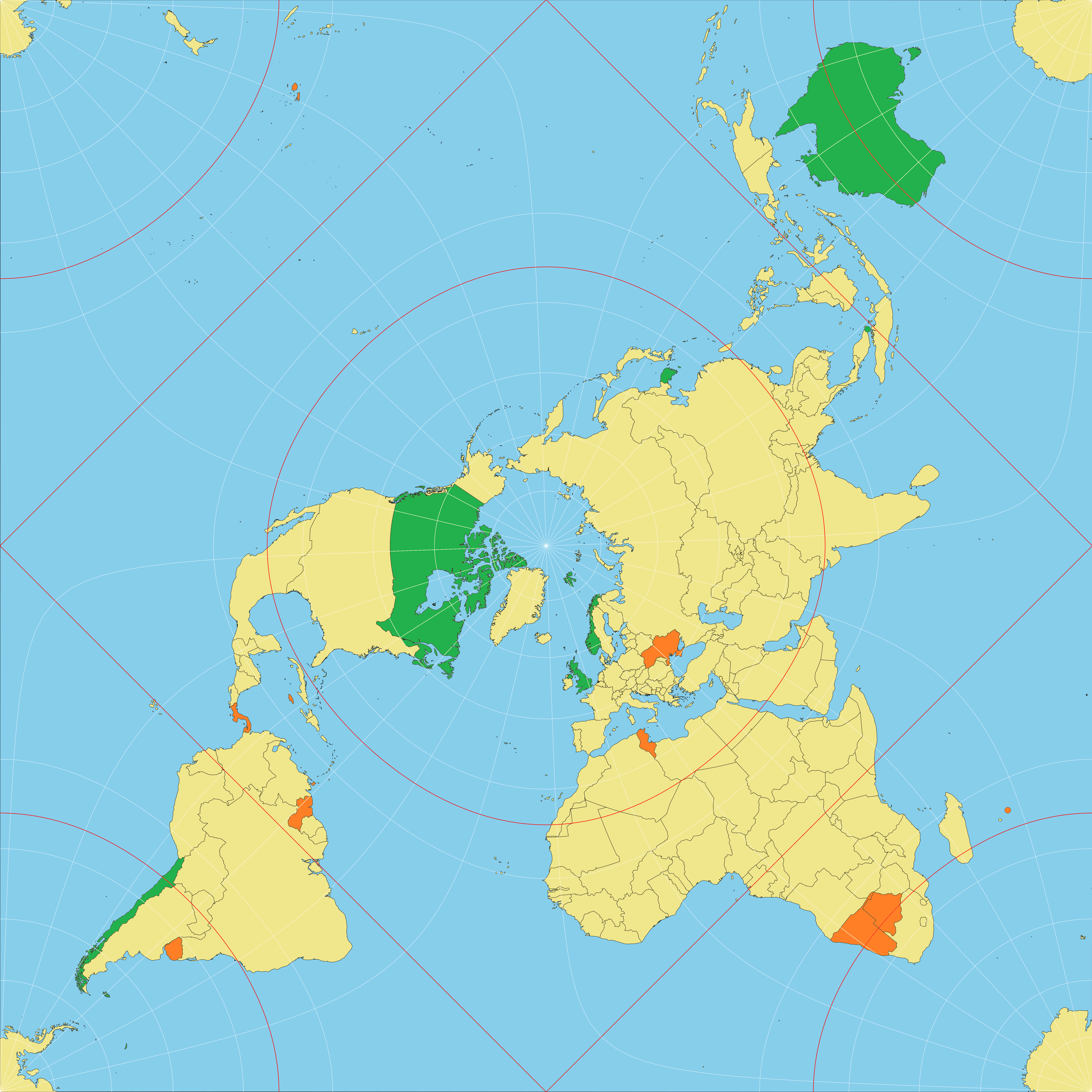
If we take just the short-list of 6 countries plus the UK (in green on the map above), this would give the bloc the following statistics:
This would be more people than Japan, Russia or Brazil - around ⅔ that of the US or ½ that of the EU. Covering an area larger than Russia, with an economy twice the size of Japan, if it were sufficiently coherent and integrated, it would comfortably sit among the great powers of the world.
Together, the orange countries make up a further 69 million in population, and around $0.5 trillion in GDP, but add presence in North Africa, the Mediterranean, Southern Africa, the South Atlantic, the Indian Ocean, the South Pacific and the Caribbean.
Obviously, this is all complete pie-in-the-sky, as without enthusiasm from both the UK government, and the governments of any prospective partners, this isn’t likely to go anywhere. Still, not wanting to be accused of the classic learned helplessness of “I’ve tried nothing, and I’m all out of ideas”, I actually went as far as writing a letter to a few UK government officials. Don’t worry - I am under no delusion that they’ll actually be read, let alone have an impact, but given the current listlessness of the UK, shouting some ideas into the void is surely better than nothing.
The great thing about an alliance like this, is that what it actually ends up looking like is incredibly flexible. It could be primarily based around defence and intelligence, like a global NATO; it could be more of a customs union, focused on trade; it could be a joint investment project, looking at collaboration in technological developments, academia, satellite systems, green energy and logistics; or it could be a bit like a lighter version of the EU, covering multiple bases including ease of movement of people, capital, goods and services. My personal take is that there is a very neat approach for which this group of countries is incredibly well positioned, which is collaborating on an international framework to facilitate nuclear-powered commercial shipping. As such, without further ado, please see the pitch that I included within my letter:
<begin letter>
An Alliance to Promote Nuclear-Powered Commercial Shipping
The current state of the world is concerning, with increased conflict and rising authoritarianism, but all is not yet lost. Democracies must safeguard the arteries of global trade, and Britain can lead the way. With the United States retreating from international leadership, your government now has a rare opportunity to shape the future of global trade, security, and innovation. I am writing to propose that Britain take the lead in forming an alliance of maritime democracies, centred around a flagship project: establishing a secure, rules-based framework for nuclear-powered commercial shipping. This would strengthen energy security, accelerate the decarbonisation of global trade, and reassert Britain’s leadership in maritime innovation.
Early collaboration with trusted partners such as Canada, Australia, Singapore, Norway, Chile, and South Korea would anchor the UK at the heart of a resilient, globally distributed alliance. One capable of safeguarding critical sea lanes across the Atlantic and Pacific, while offering a powerful democratic counterweight to authoritarian influence.
At present, the adoption of nuclear-powered commercial shipping is impeded by a range of systemic and institutional barriers:
International maritime law, including conventions under the International Maritime Organization, lacks comprehensive frameworks tailored to civilian nuclear propulsion.
Most existing protocols are designed for military vessels or stationary nuclear power plants, creating legal ambiguity around liability, safety certification, waste handling, and emergency response.
Port authorities around the world remain hesitant to allow nuclear-powered merchant vessels to dock, due to both regulatory gaps and public perception concerns, while insurers and financiers face difficulty pricing risk under such uncertainty.
Even advanced nuclear technologies, such as Small Modular Reactors, face a catch-22: limited deployment hinders regulatory confidence, and regulatory uncertainty deters commercial investment.
A coalition of aligned nations could address this impasse by establishing a shared regulatory and operational framework for nuclear shipping. Drawing on national nuclear authorities, the IAEA, and existing naval nuclear propulsion programmes, the alliance could pioneer a set of safety, liability, and environmental standards, jointly recognised across member ports. This would create a corridor of permitted routes and safe harbours, enabling early pilot deployments.
The alliance could also co-develop licensing protocols, training programmes, insurance mechanisms, and a trusted oversight body, making commercial deployment technically and politically viable. This initiative would not only accelerate progress toward carbon-neutral maritime trade; but also allow members to take global leadership in a domain with vast commercial and environmental significance.
The rise of long-range, emissions-free nuclear shipping could unlock vast efficiencies for geographically dispersed nations; particularly those with strong naval heritage, advanced nuclear capabilities, and a shared commitment to liberal values. A coordinated effort to pilot this technology would accelerate decarbonisation, create export opportunities in advanced manufacturing and nuclear components, and enhance strategic resilience by reducing reliance on congested or vulnerable shipping routes.
The Geopolitical and Economic Rationale
The UK is well positioned to shape the next era of maritime trade, especially in an era of growing geopolitical fragmentation and supply chain vulnerabilities. Traditional shipping lanes face mounting risks, from the Houthis in the Red Sea to Chinese assertiveness in the Indo-Pacific. In this context, as well as reducing dependence on fossil fuels, nuclear-powered shipping allows ships to operate at higher speeds, making longer routes more financially viable. This reduces bottlenecks, improves trade security, limits dependence on unstable energy markets, and strengthens economic ties with key allies.
While much of the world struggles to decarbonise shipping, the UK can set global standards for zero-carbon nuclear logistics, aligning with international climate goals. Developing a British nuclear-powered commercial shipping industry could revive domestic shipbuilding, create thousands of high-tech jobs, and strengthen our high-value engineering sector.
This initiative would provide a direct economic boost to key UK companies and industries, including:
Rolls-Royce: A global leader in nuclear propulsion, poised to develop maritime reactors based on its expertise in naval nuclear systems.
BAE Systems: A specialist in large-scale nuclear vessel construction, with potential for commercial shipbuilding expansion.
Babcock International: An established player in nuclear maintenance, safety, and decommissioning, well-suited to support new civilian maritime applications.
CORE POWER: A British-based company leading the push for modular nuclear propulsion for commercial shipping.
Moltex: A British-Canadian company developing processes to extract usable fuel from spent fuel rods, dramatically reducing the volume of high-level radioactive waste.
Beyond corporate gains, the economic benefits would be felt across the UK’s industrial and port cities. Growth in the nuclear engineering industry would bring thousands of skilled jobs to Barrow-in-Furness, Derby and Bristol, while drydock facilities in Glasgow, Portsmouth and Plymouth would see increased demand for ship construction and repair. Upgrading infrastructure to handle nuclear-powered vessels would also bring a windfall to major port cities such as Belfast, Felixstowe, Southampton, Liverpool, Immingham and London Gateway.
These benefits would revitalise the UK’s maritime and industrial economy, creating long-term, high-value jobs in engineering, logistics, and port management, with further opportunities arising in the service sector around export finance, insurance, legal services and naval training.
A UK-Led Global Alliance
A supranational initiative focused on nuclear maritime trade and security could lay the groundwork for deeper strategic and economic ties among this group of mid-sized, democratic, trade-oriented nations. United by shared commitments to economic growth, environmental sustainability, and collective security, this alliance would offer an agile alternative to existing blocs, deliberately avoiding early entanglement with the US or EU to prevent any single dominant power from setting the agenda. Over time, it could expand into a broader trade agreement and strategic military partnership. With a combined GDP exceeding $10 trillion, a population of 215 million, and control of key global trade routes, such an alliance would have the potential to emerge as a fourth democratic major power, complementing and balancing the US, EU, and Japan on the world stage.
Each of these countries bring complementary capabilities to this endeavour:
Canada: Commonwealth; Major producer of lithium, cobalt, uranium and rare earth elements, SMR technology, small satellite technology, Arctic patrol capabilities.
Australia: Commonwealth; Major producer of lithium, cobalt, uranium and rare earth elements, strong green hydrogen prospects, advanced robotics & naval technology, expanding satellite launch capabilities.
Singapore: Commonwealth; Global shipping hub, battery manufacturing, semiconductors.
Chile: Historical ally; Major producer of lithium, strong green hydrogen prospects, strategic launch & monitoring sites for polar orbits, Southern Ocean patrol capabilities.
Norway: Historical Ally; Leader in deep-sea mining & offshore wind, Arctic patrol capabilities.
South Korea: Anglophile nation, whose nearby international relations are too tense to permit deep local alliances; Shipbuilding, battery manufacturing, semiconductors.
The coming years could see nuclear shipping emerge as a game-changer in global logistics. If the UK acts now, it can set the global regulatory framework, secure first-mover industrial advantages, and solidify its role as a world leader in maritime innovation.
Beyond the technical and economic rationale, this initiative resonates with Britain’s deeper identity. It eschews nostalgia, instead offering a modern, forward-looking expression of our maritime heritage. This is an opportunity not just to secure Britain’s economic future but to reaffirm its global leadership in free trade, security, and clean technology. I urge your government to take this forward, positioning the UK at the forefront of the next great transformation in world trade.
<end letter>
Afterword
I am sure that there are many directions from which this idea can be criticised, but I would be far more welcoming of interesting alternatives. After all, it is much easier to tear something down than build something up. I think this is a very long shot, but in the current increasingly unstable global environment, there may never be a better time to try it.
[Note: since writing this essay, I actually did receive a reply from one of the departments I sent the letter to! The Department for Transport has assured me that they are working with industry to investigate how SMR technology might be applied to commercial vessels, and that they are engaged with the IMO and IAEA in developing international safety standards. They also mentioned that “On 18th September 2025, the UK and the US agreed a Technology Prosperity Deal to develop mutual interests in science and technology”. While this isn’t quite the visionary geopolitical leadership that I am pushing for, it is certainly better than nothing.]
Edit: my main point with this article was around the UK’s approach towards internationalism and alliances, however quite fairly several people have pushed for more detail on the “nuclear powered shipping” angle. A single 2-week Pacific crossing of a large cargo vessel uses $1.5mn of fuel, while the cost of a new large cargo vessel can be $300mn (of which ~$60mn is the engine). Sea freight is very cheap, only because of the enormous economies of scale that spread these huge costs over the billions of items being shipped.
In contrast, the cost of uranium fuel for these journeys would be only 10-20% of this ($5-10 per MWh), so you could be saving close to $40mn per year in fuel on a single ship. The largest cargo ships use about 80MW of power, and the current cheapest (still largely experimental) SMRs have capital costs of about $4mn/MW, so an adequate power plant would currently cost at least $320mn. This is an enormous sum, at $260mn more than current heavy-fuel-oil engines, roughly doubling the cost of a ship, however the fuel savings would make it break even within only 6.5 years! As SMR technology improves, it is likely to become much cheaper, and improve this calculation further, and a great way to do this would be to have an international program of government investment seeking to create a new market for the technology.