
Regulation has been a key point of contention in politics for a very long time. On the whole, right-wing (“atomised”) governments tend to rail against regulation as an impediment to growth and left-wing (“obliged”) governments tend to increase regulation as a guard against corporate exploitation. This political dichotomy naturally leads to very simplistic approaches - either all regulations are bad, and we need a “bonfire of regulations” to revitalise the economy, or all existing regulations are necessary, and any new problem can be resolved by adding a few more.
I find both of these viewpoints quite prevalent in online discourse, with very little nuance or acknowledgement that the answer might be somewhere in the middle. At any given point, there can be good regulations and bad regulations in place, and whilst I might reject the stances of “we need fewer regulations in general” and “we need more regulations in general” as overly simplistic, stating “we need fewer bad regulations and more good regulations” is uninformative and vacuous.
It is therefore worth exploring the question - just how bad/necessary actually is regulation? Unintended consequences often abound as a result of regulation, so what can be accomplished without regulating, and which regulations are worth the price?
The impulse to regulate, especially pre-emptively, before any other potential solutions have been attempted, can indeed be damaging. Rent controls are a great example of this – a popular policy in many geographies, that seems to solve the problem of unaffordable housing, but with unfortunate side effects of:
Discouraging the building of new homes, due to lower returns
Reducing individual’s mobility by often tying their entitlement to cheap accommodation to their length of tenure or their residence in a particular locality
Depressing the local economy by preventing more people from moving to the area due to an inability to develop higher density housing
That is not to say that unaffordable housing is not a problem, or shouldn’t be addressed, but instead that resolving the root of the problem (restrictive planning laws, zoning, inefficient use of land, perverse incentives) may lead to better long-term outcomes and fewer unintended consequences.
Since the days of Adam Smith, it has been thoroughly established that markets are very good at solving a wide variety of problems, and at allocating resources to where they are needed. It is therefore usually counterproductive for governments to try too hard to micromanage them. There are plenty of examples of bad regulation, and these get trotted out every time a government wants to cut regulation, but I think this leads many people to think that all regulation is bad.
“If only the government would get out of the way and let everyone do what they want, we would all be rich and free” - many people
There are however regulations that are hugely beneficial. My argument is that most of these are beneficial precisely because they actually improve the performance of capitalism and markets. Whilst capitalism and free markets are very powerful tools that can be used to bring about enormous growth and wellbeing for humanity, I have already written about how they can also do great damage if left completely unchecked. It is my view that the regulatory role of the government should be to ensure that these tools are effective, and well aligned with our wellbeing.
Economist Bryan Caplan recently laid down a gauntlet, suggesting that anyone that claims to support the free market, but is also in favour of some amount of regulation, must specify at least one market that they wouldn’t want to regulate at all. Otherwise, he claims that they are “abusing language”, and are not in fact starting from the theoretical presumption that “free markets are optimal”. As much as I respect Caplan’s expertise, I find this an odd requirement - every market is going to have some kind of harmful exploit that will eventually be found and… exploited. Any sufficiently new market naturally lacks regulation, and has a wild-west-like quality, while people explore the limits of what is profitable. The need to regulate only becomes apparent once it has become mature enough that people have found a few highly profitable but societally damaging activities, and started to exploit them.
Instead of using his rather overzealous shibboleth to out the “anti-market” pretenders, I suggest that it is instead more helpful to ask people to provide concrete examples of which markets should be regulated dramatically less, and which regulations should be removed. If someone is not able to do that, then they may indeed only be pretending to be pro-market. To this end, here are details on some specific issues that I personally think would be helped by removing regulations:
A couple of articles on the regulation of the US housing market
A list of regulations that currently hamper US childcare and healthcare
A couple of articles on regulations that are hindering the development of UK infrastructure
In the UK, the financial promotion restriction under the Financial Services and Markets Act 2000 needs to go. This rule currently prevents startups from openly marketing investment opportunities, so removing it would broaden access to capital beyond VC/angel networks
The mandatory sponsor requirement under the UK’s Financial Conduct Authority listing rules needs removing. This currently forces companies to rely on investment banks if they want to become publicly listed, leading to high IPO costs and giving these banks enormous gatekeeping power
I’m not expecting everyone to agree with these, but hopefully they at least demonstrate that despite my argument that some regulation is necessary, I don’t secretly hate the free market.
1. The Limits of Free Markets: Reality Vs. Theory
1.1 The Ideal Free Market
When Adam Smith talked about the “invisible hand of the market”, he had a particular vision of what “market” meant. In an ideal market, things flow with little resistance and are allowed to reach an equilibrium. An ideal market does a great job of getting what people want, where they want it, as cheaply as possible.
The key conditions necessary for this to work are that people behave rationally, there are many buyers and sellers of any given product, and there is no coercion. I will give more detail on each of these conditions, as it will be necessary to see when each of these might not apply later:
People behaving rationally, simply refers to the idea that markets work best when people don’t take actions that are not in their best interests, like buying things that they don’t actually want. This sounds like it should be easily satisfied for any individual that isn’t actually insane, but the situation isn’t always quite as clear-cut as that.
Many buyers and sellers competing means that no individual entity is particularly important or influential. Monopolies, oligopolies, monopsonies and oligopsonies all obviously break this condition, by having entities that are able to exert great influence over the price and volume of a product that is on the market. More than this though, in an ideal market, there would be many sellers competing, all offering largely the same product, driving down prices for consumers, whilst at the same time, many buyers are competing to buy them, allowing an equilibrium to be reached. There would also be low barriers to entry, so that new entities can enter the market and compete, driving out inefficiencies.
No Coercion implies that people are not compelled to buy a product - they can decline if the price isn’t right. Some libertarians would consider this condition to be satisfied as long as you don’t have a literal gun pointing at you. I think that it is reasonable to consider, for example, that starving people are compelled to buy whatever food they can find, even if it is more expensive than they would like, as the alternative is still death, even though nobody is directly threatening them. People’s decision making process fundamentally changes when their life is on the line, and it is this change that would make market conditions deviate from the ideal.
By achieving these conditions, an ideal market is able to reach an equilibrium in which it is not possible for a player to gain market share by lowering their prices, as this would make them lose money. This is indeed how markets work for fungible commodities - products that are completely indistinguishable from each other.
Milton Friedman was a huge advocate of free markets, and describes very clearly their benefits and how they work. He argued passionately against government regulation that would interfere in the market, and made the point that even under situations where the ideal conditions are not met, markets can still foster competition and drive down prices for the end consumer. For example even if railways were a monopoly, people can still drive, fly or teleconference, applying downward pressure on the railway’s pricing.
That being said, as a market moves further and further away from the ideal conditions, it does get less effective and less reliable. At some point, relying on a sufficiently dysfunctional market could become actively harmful.
As you can probably imagine, profits in an ideal market are very low, so every company is incentivised to make the market a little less ideal. Product differentiation and market segmentation are tools used to reduce the number of direct competitors, and many large companies actually encourage bureaucratic regulations that make it harder for new companies to enter the market. Marketing is used to increase the social pressure that people feel to buy a product, making people more willing to accept higher prices, or convincing them to buy a product that they otherwise wouldn’t have wanted.
Ultimately, whilst many people see capitalism and free markets as going hand in hand, there is a tension here. It is actually in every successful capitalist’s interest to make the market a bit less free, in a way that benefits them, in order to increase their profit margins.
This is not some conspiracy theory - in his book Zero to One, Peter Thiel explicitly states that the objective of a budding entrepreneur should be to create a new monopoly. It is a common idea in left-wing circles that it is impossible to become a billionaire ethically, and this may be a more neutral way to frame this idea - it would be virtually impossible to achieve that kind of success without finding a way to subvert the market somehow.
The three conditions required for an ideal free market were people behaving rationally, many buyers and sellers, and no coercion. Let’s look at each of these in turn:
1.2 When Assumptions Fail - Rationality Challenges
It is undeniable that people do not always act entirely rationally or in their own interest. People can of course be foolish, and do things against their own self-interest, but in most cases these people are largely uncorrelated, so their impact on the market cancels each other out.
It is where these tendencies affect large numbers of people in a very similar way, that they could render a market less than ideal. A simple example of this is drug addiction, where people make exceedingly harmful choices for short term gain at the expense of long term goals and stability. Sufficiently addictive drugs are usually banned in some form by governments, as otherwise it would be too easy for companies to legally predate on people, get them addicted, and profit from their newfound desire to spend every penny on getting high. Misinformation is similarly easy to see how it could drive irrational behaviour, but much more difficult to resolve without infringing on people’s civil liberties.
Cultural norms can lead to people behaving in a highly correlated and irrational manner, to the extent that entrepreneurs trying to exploit an opportunity that defies cultural norms can be met with loss of business, boycotts or even violence. There are a few examples of this occurring when US businesses started hiring black workers or women, but such boycotts and protests were ultimately unsuccessful in the long run, and the culture changed to accept the new status quo. There are many places however, where the story is not yet so positive, for example Dalits in many parts of India still face enormous resistance to their businesses from other castes.
A far more subtle cultural correlation arises from education. Some groups of people tend to value education more, and are willing to spend more money on it, while others are often less inclined to invest in education. In the mid-20th century, many families in Northern England rejected the idea of higher education for their children, despite the inexorable decline of jobs in the mining industry. Equally today, many middle class families eschew lucrative trades and apprenticeships for their children in favour of pushing them towards university, despite the declining job prospects for graduates. This cultural inertia is either driven by a failure to update to the prevailing economic conditions, or perhaps more likely, driven by class based conformity - “we’re not like those posh people; university is for people who don’t know how to do real work”, or “we’re not like those uneducated poor people; blue-collar work is for people who don’t know how to think”.
Even rational behaviour can lead to poor outcomes when built on flawed models or false premises, for example the hedge fund Long-Term Capital Management used a shiny new theory to make billions, only to lose it all when the theory failed (the first formulation of Black-Scholes assumed Gaussian randomness, causing massive prediction errors under heavy-tailed events). Again, if we assume there are lots of people with lots of uncorrelated theories, this is not a problem for the free market, but there are far fewer high net worth and sophisticated investors, and they can be quite highly correlated. In “23 things they don’t tell you about capitalism”, Ha Joon Chang argues that it can be beneficial to impose some constraints on markets that serve to simplify the market, as this allows for greater understandability, and therefore allows more people to engage with them.
Finally, we have to address marketing. Advertising and other marketing strategies can serve as a powerful force for shaping consumer behaviour, often in ways that exploit psychological vulnerabilities rather than promoting rational decision-making. Companies can use adverts to subtly or overtly influence public perception, nudging people toward consumption patterns that may not be in their best interests. This could be as simple as stoking people’s inherent desire for status symbols to “keep up with the Joneses”, or encouraging unsustainable consumption through borrowing - “buy now, pay later”. More than this however, many marketing strategies rely on creating dissatisfaction - convincing people that something is wrong with them or their lives, and that a product is the solution. A classic example of this is the creation of a market for women’s razors - before the 1920s, there was no stigma attached to women’s body hair, but through the efforts of razor companies, societal pressure was created, opening up a whole new market for their products.

This manipulation becomes particularly troubling when paired with imperfect information: the average consumer cannot be expected to research every purchase in detail, and thus becomes vulnerable to persuasive but misleading messages. When consumers consistently operate under such skewed incentives and limited information, the assumptions of rationality and perfect knowledge that underpin market efficiency begin to unravel. Unlike individual irrationality, which tends to cancel out in markets, systemic manipulation through advertising creates correlated distortions. Left unchecked, marketing can exploit cognitive biases, reinforce harmful social norms, and make people fundamentally less happy with their lives than they otherwise would have been.
Andrew Kortina (one of the founders of Venmo) has a particularly insightful take on the changing role of marketing in modern capitalism. Using poorly aligned artificial intelligence as a metaphor for capitalism, he observes that whilst growth in production capacity is an early success of capitalism’s tenet of maximising shareholder value, this tenet eventually stops being aligned with human flourishing. Once production capacity is large enough, the bottleneck preventing ever greater shareholder value is limited demand, for which marketing can be used to drum up demand and increase sales. Once marketing is pervasive enough, the bottleneck is then limited attention, so the market needs to find a way to catch and keep people’s attention, so that it can shove even more marketing down their throats. Enter social media feed algorithms, doomscrolling, TikTok influencers and clickbait.
It is not that social media is inherently a cancer eating away at our society, our minds and our children’s mental health… I mean, social media is currently doing all of these things, but this doesn’t necessarily have to be the case. It is this way, because regulation hasn’t kept up with the blistering pace of technology, which has allowed the “attention economy” to be ruthlessly optimised. Even now, most government attempts to regulate social media consist of exceedingly blunt, ineffective and authoritarian knee-jerk proposals like banning children from having accounts. Instead, careful regulation of how these algorithms should be allowed to behave would likely have a far greater impact, but this is of course far more complex and nuanced. Hank Green makes a number of good points about the deliberate decisions made by YouTube to hijack children’s attention in his video announcing the launch of ClockwiseTV.
1.3 When Assumptions Fail - Market Concentration
Monopolistic Behaviours
The fundamental drive of capitalism to extract as much profit as possible leads it into conflict with the free market, which serves to drive down profit margins instead. Companies are therefore always trying to find ways to subvert the market, and monopolistic practices can be a very successful route to achieving this.
A common metaphor for wealth is pie - everyone gets a slice of pie, and everyone wants more. Some people see wealth as a zero-sum game - to get a bigger slice of pie, someone else has to lose some of theirs. Economic growth however can be viewed as ”growing the pie” - instead of viewing it as a zero-sum game, you grow the economy so that everyone’s slice gets bigger at the same time. Monopolistic behaviour and regulatory capture are good examples of zero-sum thinking - instead of allowing the free market to generate economic growth, companies try to hobble the market, preventing competition and innovation. This grabs them a bigger section of the pie, while the pie itself stays the same size or gets smaller, meaning less pie for everyone else.
Companies can often make a very good argument for mergers and acquisitions - economies of scale are a real thing, allowing for efficiencies and cost saving that can be passed on to the consumer through lower prices. This has been used as an argument to justify enormous mergers that have dramatically increased the concentration of businesses within a sector. In the UK, the Competition and Markets Authority has blocked several mergers that might have reduced competition too much. For example in 2019 the CMA prevented the supermarket chain Sainsbury’s from acquiring ASDA, on the basis that the resultant company would have too much negotiating power over suppliers.
Was this action anti-free-market? It certainly went against the desires of the leadership of Sainsbury’s and ASDA, but this isn’t a bustling street full of independent vendors, that Milton Friedman likes to reference. Instead, this is an entity that is approaching governmental levels of control over a segment of the market - forcing suppliers to accept their prices, else their produce rots and goes to waste. Here is another article extensively detailing multiple instances of price-fixing in the US grocery sector:

Companies also often lobby governments to pass regulations that increase the barriers to entry to a particular sector. This is a large source of the regulations that people like to rail against, but it often benefits every existing large company in a given sector by reducing their future competition therefore making the market they operate in slightly less free. A large company can of course afford a team of lawyers to ensure that they are in line with the regulations, where a small company may not be able to, and this is a small price to pay to stop upstarts from eating your lunch. This is frequently portrayed as ensuring public safety or consistent standards, despite mostly just increasing the costs of compliance for newcomers, and being a form of regulatory capture.
Other more subtle techniques can be employed too. Local communities often rail against large chains opening up in their area, harming local businesses. This can be seen as pure NIMBYism - after all, if people end up shopping there, at the expense of the other local businesses; that is a victory for consumer choice, and the other businesses should have worked to find more efficiencies and lower their prices. A large national chain entering into a small local market may have many legitimate advantages (volume discounts, access to wider pools of labour for head office/support functions), and they will force local businesses to adapt and innovate; perhaps to offer a more localised or tailored product, that the national chain does not have the flexibility, focus or dynamism to provide. This kind of success story can indeed sometimes be the case, after all, nothing provokes small-town rage quite like interlopers making changes to things. It does however hide a much more insidious practice - national chains have much bigger balance sheets, and much deeper pockets, so they can operate at a loss.
This allows them to undercut their competitors, and keep undercutting them until they are forced to close. At this point, having quashed the competition, they are effectively a monopoly supplier, and can raise prices at their leisure. Local entrepreneurs will know better than to try to challenge them, as they know that the national chain can operate at a loss for longer than they can. Walmart has had some rulings against it at a state level (Oklahoma, Wisconsin & Arkansas), but predatory pricing is rarely challenged successfully in the courts, as (at least in the US) the plaintiff must not only demonstrate that a company was selling below cost, but they must also prove that the company could recoup profits through monopoly pricing afterwards - a very difficult evidentiary requirement. Amazon has also been frequently accused of pricing things below cost, and engaged in a price war with Quidsi to keep a new entrant from threatening their online retail hegemony. They conveniently avoided any legal challenge by acquiring Quidsi in 2010 and then shutting them down in 2017. Predatory pricing was also used multiple times by major airlines to crush attempts to offer budget transatlantic flights - Laker Airways and People Express were both start-ups in the ‘80s that were forced out of business in this way, and more recently Norwegian Air experienced this practice, before COVID finished off their long-haul aspirations.
Other techniques that companies can use to keep competitors out include:
“Killer Acquisitions” aimed at eliminating future competitive threats, like Facebook’s acquisition of Instagram and WhatsApp, the Quidsi example above, or Apple’s failed acquisition of Dropbox
“Self Preferencing” where a company that runs a platform also competes on that platform, and is therefore able to favour its own products, such as Amazon prioritising products that are “fulfilled by Amazon” for its “Featured Offer” status, or Google promoting its own services in search results
I want to make clear here that I’m not just rabidly criticising Amazon/Apple/Walmart out of some sort of hatred of capitalism. These companies have all contributed enormously to cheaper products being more available to more people. We could try to calculate whether they have been a net positive or net negative for society, but this would be incredibly difficult and unavoidably subjective. I am personally inclined to think they are still net positive, but that is not really the point. The point is that if these negatives can be reduced without too much reduction to the positive effects of capitalism, it would be a huge benefit to society.
One goal that many companies try to achieve is “Commoditising their complement”. In some respects, this is great for consumers, as the monopolist makes every other part of the supply chain cheaper, and some of these savings are likely passed on to their customers. It does however prove the point that monopolists have an enormously large ability to influence the behaviour and structure of the wider market, which should give us concerns about who is really benefiting.
Intellectual Property provides a complex interplay between incentive to invest and market efficiency. Patents introduce inefficiency, effectively providing government approved monopolies on certain products and technologies, however without them, there may be less incentive to put the research in, as you would never see the benefit. Copycats would drive down the price very rapidly, denying you the supernormal returns necessary to recoup your investment. Patents are anti-free-market, but it can be argued that this is beneficial, at least to a point. In the US and EU however, IP protections are very strong and long lasting indeed, prompting many to consider that they are interfering with the free market too much.
There is also a broader pro-monopoly argument, that the surpluses generated by monopolists allow them to invest and innovate in ways that wouldn’t be possible for companies that had lower margins due to the competition. Some companies with significant market power do use their surpluses to develop new products and services, which have spillover positive effects for society; for example Xerox in the 1970s was able to fund research that directly contributed to many modern computing standards, and Google more recently was able to fund research that led to AI advances such as Alphafold. The issue with this argument is that firstly, not all monopolistic companies do this, and secondly, there is no reason to assume that this innovation would be impossible without the monopolists - investors regularly provide funding to start-ups with novel ideas that take significant investment to bring to market.
It is true that in many cases a monopoly in one area may be able to be overcome with substitutes, for example a railway monopoly will still have competition from airlines, and even from teleconferencing to a certain extent. However, whilst substitutes may place some limits on how extreme a monopolist’s behaviour might be able to be, the monopoly is still very problematic for the market and for society. These substitutes will be a less than ideal solution for many people, and frictional effects or coordination issues will prevent some people from substituting at all.
Overoptimisation and Fragility
There is another category of problems that can arise from market concentration: larger companies can indeed operate more efficiently, however it is possible to overoptimise, and an overreliance on a small number of large companies within any particular sector leads to fragility, wherein shocks (economic, political, natural or otherwise) can have catastrophic effects on the sector, economy and society at large.
The popularity and spread of lean manufacturing from Toyota to most other car manufacturers (and many manufacturers in other sectors as well) is a great example of how optimisation can increase fragility. Enamoured by the cost savings achieved by Toyota, many businesses adopted lean “Just In Time” processes in order to cut down on inventory costs, however most applied the principles too broadly, not appreciating the subtlety of Toyota’s approach (strategic inventory planning and supplier resilience, ensuring supply of business critical components in adverse scenarios). This meant that when Covid-19 hit, many car manufacturers were left scrabbling for certain key components, and had to massively dial back production.
Of course, car manufacturing isn’t a monopoly, but it is nevertheless dominated by a small number of very large firms, which makes it very easy for all of them to end up taking a similar approach or listening to the same advice. The excessive optimisation led individual companies to be fragile, and vulnerable to shocks, but the market concentration also resulted in a loss of diversity that made the entire industry vulnerable. Much like the 2008 financial crisis, excessive concentration within a pivotal sector can make companies “too big to fail”, such that their downfall could be catastrophic for an economy.
Another example of the trade-off between industry resilience and industry efficiency can be found in computer chip manufacturing. In the early 1990s there was a huge shortage in RAM chips, causing a significant price spike that persisted for quite some time. This was caused by a fire at a Sumitomo Chemical Ltd. factory that produced 60% of the global supply of a particular resin required for RAM chip manufacture. Similarly, flooding in Malaysia in 2021 also disrupted chip production for multiple businesses that had all located key factories in the town of Shah Alam.
It can be argued that both of these events demonstrated the free market operating perfectly - prices went up, incentivising customer companies to conserve chips, and supplier companies to ramp up production. Eventually the situation was resolved, and the market proved its resilience once more. There is however a more concerning way to view these events.
Clearly there are huge efficiencies to be made by having larger factories, and by locating factories where there is an existing pool of skilled labour and supporting industries. Companies will make higher profits if they exploit these efficiencies, so the natural tendency is to have fewer, larger factories, often located in very similar locations. As technologies become more and more specialised and capital intensive, these effects grow, and modern semiconductor fabrication plants are the apotheosis of this trend. Due to the sheer expense of these semiconductor “fabs”, not much spare capacity gets built, so a single fab going offline has a material impact on global output, and the lead time for their construction is quite long, so replacing lost output cannot be done quickly.
The concern here is that this trend leaves a critical global industry vulnerable to disasters (or in this increasingly multi-polar geopolitical climate, deliberate attacks). A single natural disaster (or attack) could destroy a large fab, or cluster of fabs, and this could create shortages that would last for years, despite the price incentives that the market would generate. This risk is also present in the concentration of critical knowledge - much of the understanding around how best to lay out cutting-edge CPU logic circuits is highly commercially sensitive, carefully guarded by the companies that design them. This understanding is often based on unpublished heuristics, relying on the experience of a small number of highly specialised individuals. Losing a factory would be bad enough, but losing too many of these people as well, would be a catastrophic loss of institutional memory, and could set the sector back by decades.
Uniformity of Thought
As a final instance of market concentration, we can consider an individual’s wealth. As wealth inequality increases, the ever larger numbers of comparatively poorer people have less and less market power. This reduces their ability to express to the market what makes life better for them, and reduces the willingness of the market to cater to them. Companies and entrepreneurs are always having to decide between different investment opportunities, and they will usually pick the one with higher returns. Why make a cheap car with a low profit margin for people that can barely afford it, when you could make an expensive car with a very high profit margin that rich people will buy instead? Of course, everyone’s money is just as good as everyone else’s, so there is still money to be made with both opportunities, but the lower margin one requires huge volumes to be sold in order to achieve similar profits, so it will require more capital investment, be a higher risk and will attract fewer players.
In addition to changing the relative appeal of different investment decisions, this wealth concentration also affects investment decisions directly. The more concentrated wealth becomes, the fewer people are going to be able to have a meaningful stake in companies through the stock market. This means that the market feature that “foolish people are random noise that cancels out” starts to fail, as it ends up heavily influenced by a comparatively small pool of high net worth individuals, executives and hedge fund analysts. These people are undoubtedly highly skilled, but they can easily become very correlated, and subject to systematic model errors. With large numbers of people involved, there will be a wide variety of approaches to investment, however the smaller the number of people that have the ability to invest, the more likely it is that strategies and risks could be missed. This exposes the market to possible systematic problems or “black swan” events. Of course, anyone that does notice an underutilised strategy or an unrecognised risk can make a huge amount of money on the stock market, but that doesn’t avoid the large societal cost of market crashes and subsequent recessions.
Even without individuals with excessive wealth, large fund managers have a similar effect. Despite technically only managing assets on behalf of their customers, the big fund managers (Blackrock being the biggest, with $11.6 trillion of assets under management) have disproportionate levels of influence over the market, as they control massive stakes in every big company on the market.
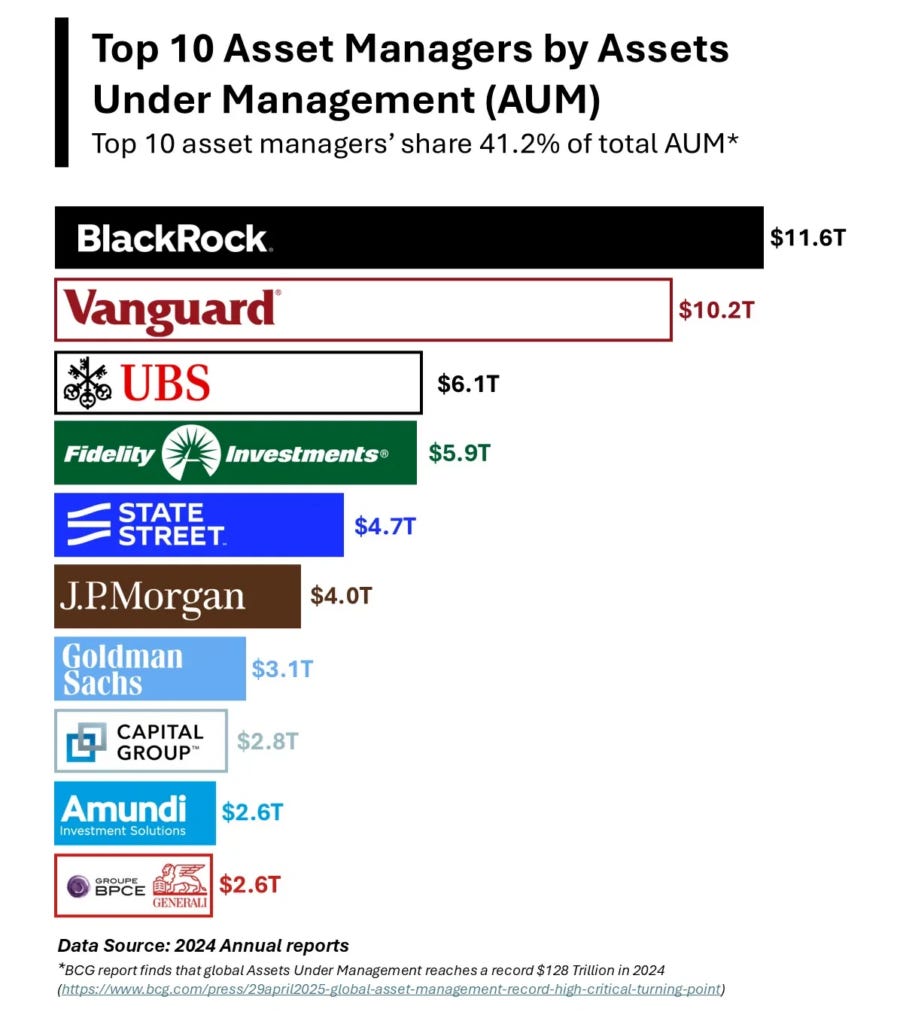
There is also an argument that passive index funds are themselves pushing the market towards a kind of uniform monoculture. Matt Levine has written several times in his Money Stuff column at Bloomberg, about how the sheer volume of investment that goes through index funds is resulting in a degradation of the market, and Nicholas Decker has more recently written a post on this concern. One issue is that if most of the money in a market is passively invested in proportions based on the market capitalisation of each respective company, then none of this money is taking part in price discovery, which is what powers the “invisible hand of the market”. Index funds are purely price-takers, reinforcing the existing hierarchy of businesses by capitalisation. If this is a big enough proportion of the capital in the market, it could obscure the price discovery that is being done by active investors, and if it is a big enough proportion of the investors in the market, it could again mean that the price discovery is being done by a comparatively small pool of individuals, raising the risk of correlation and systematic pricing errors. One of Matt Levine’s other points (that has been raised by others too) is that index funds invest in multiple companies that are in direct competition with each other. This could have the effect of decreasing competition (and therefore also innovation), because if one company wins at the expense of another, the index fund shareholders don’t care. Being able to easily invest in multiple direct competitors removes the investor’s incentive to try to pick winners, and makes them less in favour of strategies that could cause disruption to an industry.
In a final example of uniformity of thought, we can look at Private Equity. I need to caveat this by stating that not all Private Equity is bad, and much of it is in fact very positive - the business of taking a struggling business and turning it around can be very beneficial. Nevertheless, from the 1980s onwards a particular style of aggressive financial optimisation became highly fashionable across both private equity and management consulting. Companies were increasingly viewed less as long-term institutions and more as collections of assets and cash flows to be optimised for shareholder return (see this article by Peter Smith about Jack Welch, the CEO of GE). Heavy cost-cutting, layoffs, outsourcing, asset sales, debt-loading and the disposal of supposedly “non-core” activities often did produce impressive short-term financial improvements, particularly in genuinely bloated firms. However, as these methods became accepted almost as doctrine, they were frequently applied too broadly, including to fundamentally healthy businesses. In many cases this removed not inefficiency but resilience: experienced staff were lost, investment was deferred, customer loyalty weakened, and companies became more fragile and heavily indebted. Famous collapses such as Toys “R” Us, Debenhams and Sears became emblematic of concerns that short-term financial engineering could ultimately hollow out otherwise viable firms.
When one particular management strategy becomes a dogma, accepted across swathes of equity and management, significant economic value can be lost. It can be argued that the market did eventually solve this problem, because investors have grown wise to these strategies - PE firms are now struggling to exit from excessively pruned companies that they might have previously easily sold, which should discourage excessive use of this strategy in future. On the other hand though, there is still the cost of many years’ worth of failed businesses that resulted from this group-think.
1.4 When Assumptions Fail - Coercion and Friction
A market is clearly not free if the people participating are being coerced, but a threat can be far more subtle than a gun pointed at someone’s head. Any situation in which people’s lives are at risk can be market distorting, for example in some circumstances a starving person might be driven to trade their home for a loaf of bread, to allow them to survive. This does not make the market price of bread equal to that of their house, unless there is a global food crisis of apocalyptic proportions - rather it is likely a feature of their individual situation. Commonly referred to as price gouging - the ability of people to charge above the odds for products in survival situations can be evidence of market failure.
Some people argue that price gouging is not a problem - the ability of sellers to set high prices is a reflection of the difficulty and cost of sourcing goods in a particular area, and that the prospect of supernormal returns will attract other sellers to the scene, driving prices down. This is of course sometimes true, and tends to be the case over a long enough timescale. Rules against price gouging have indeed hindered relief efforts in the past, where a hurricane stricken region has been unable to access electricity, and the government prevented the sale of back-up generators due to their high prices.
This is however a relatively benign example of price gouging - if you are in need of electricity, you might be willing to pay double for a generator, providing a useful market signal that there is profit to be made here, encouraging other people to increase the supply. You probably wouldn’t be willing to pay ten times though, unless you were very rich - you’d live without electricity for a few days longer, until a better offer came along. You certainly wouldn’t swap your house for a generator no matter how rich you were - that wouldn’t even make any sense. This keeps the price gouging from becoming too extreme.
In a situation in which the risk to life is more immediate, the calculation changes. Without food, you might not be willing to wait more than a couple of days before you would be willing to trade your car for a decent meal. If you were dying of thirst, you would reach a point that you would gladly trade your house for a bottle of water. These transactions do indeed still signal to the market that there is a profit to be made through increasing the supply, however the impacts on the individuals in question are disproportionate. The time it takes for the market to drive down prices is too long for it to be of any benefit to the people who traded in their home. It isn’t a situation where a few rich people can spend huge amounts, and everyone else can wait until the price comes down a bit - if you don’t get what you need right now, you die.
What is more, in any situation where people are desperate and profit margins are high, there is a perverse incentive to keep people desperate, so that profits remain high. This is one of the many reasons why organised crime so often flourishes in desperately poor areas - by using force to keep out the competition, you can keep the people desperate, and maintain your high margins. Although clearly illegal, this can be hard to contain, as the criminal enterprise is able to make so much money. This is another reason why many governments choose to make all gouging illegal, so that they can nip such situations in the bud, before they get out of hand.
An underlying economic circumstance that often results in coercion and friction, is that of inelastic demand within an industry. Health insurance in the U.S. epitomises this issue. Most Americans receive insurance through their employers, severely limiting choice and therefore making people less responsive to price changes, while emergency medical care is inherently inelastic - when you need it, you can’t shop around. This allows insurers to maximise profits by charging higher premiums, and offering less coverage than would be possible in an ordinary free market. The only other way that health insurers could generally improve their profit margins was by reducing their exposure to risk, and historically they achieved this by avoiding coverage for those who needed care the most, which led to regulations like the Affordable Care Act’s ban on pre-existing condition exclusions. High prices and poor service are still endemic however, as this regulation has not resolved the fundamental issue of inelastic demand, which all other wealthy nations resolve through some form of direct government involvement to guarantee universal coverage and spread risk across the entire population (either the National Health Insurance model of a “single payer”, the Beveridge model of the NHS, or the Bismarck model of highly regulated non-profit insurers).
Moving away from threats to people’s lives, there can still be the problem of too much friction in a market. For a market to function, people need to be able to actually make choices, or at the very least vote with their feet. People on low enough incomes can be quite geographically constrained, being unable to afford transport. Even if they can get a bus somewhere, they cannot afford a rental deposit, so are trapped in an area where the options they want are not available, rendering them unable to express their preferences economically. This can put people into a catch-22 situation, where in order to get a better job, they need to move or buy a car, but they can’t move or buy a car because they don’t have the money (and they don’t have good enough credit to borrow, or the only people willing to lend are unscrupulous loan sharks who will break your legs).
Even in the absence of crushing poverty, people are often more tied down than would be ideal – couples wanting to move may need to both get new jobs simultaneously, which makes the move take longer or not happen at all. Moving house itself is a long, complex and arduous process that is generally considered among the most stressful events people typically experience. All of these things add friction into the market, making price corrections take longer, making the market less free and less efficient.
From this, we can conclude that poverty, geographic constraints, and survival pressures all undermine true freedom to choose. This places limits on where markets can be considered an appropriate tool. Economist Michael Sandel talked at length about this limit on a panel at Columbia University, from which I have drawn this rather salient quotation:
“We’ve drifted from having a market economy to becoming a market society. The difference is this: a market economy is a tool, a valuable and effective tool for organizing productive activity; but a market society is a place where everything is up for sale. It’s a way of life in which market values and market thinking begin to reach into almost every spirit of life--- family life, personal relations, health, education, civic life, politics.” - Michael Sandel
2. Why Regulation Matters: Preserving the Market’s Strengths
2.1 Regulation as a Balancing Act
We have established that markets are powerful tools for organizing human activity, efficiently allocating resources, and fostering innovation. Without intelligent rules however, the game can be rigged - not always by malice, but through the cold logic of game theory. In unregulated markets, self-interested behaviour leads to predictable failures: wealth accumulates at the top without trickling down, and dominant firms crowd out smaller competitors. Regulation, when carefully designed, can shift these equilibria toward outcomes that serve the public good - ensuring fair competition, preventing runaway consolidation, and preserving the dynamism that makes markets thrive.
Unchecked market concentration is one of the clearest signs of imbalance. As firms grow, they benefit from economies of scale and network effects that allow them to dominate sectors. When too few players control too much, markets become fragile - less resilient to shocks, slower to innovate, and more prone to coordinated price-setting or supply restriction. Worse, when companies grow so large they rival the power of the state, they may influence laws in their favour, undermining democratic governance. The phenomenon of regulatory capture - where watchdogs become lapdogs - is not theoretical. Corporate lobbying has stymied essential reforms for decades, from banking oversight to environmental standards. The long battle waged by scientist Clair Patterson to remove lead from gasoline, against fierce opposition from industry-funded lobbyists, is a stark reminder of how hard it can be to force necessary change when profits are at stake. The government must tread a fine line, preventing concentration of power while not becoming the distorting force itself.
This balancing act is often difficult and subtle, requiring regulators to have a deep understanding of the relevant markets and products. One area where things are slightly more clear-cut however is regulation around addictive substances or habits. While most governments stop short of banning tobacco or gambling entirely, as this infringes too much on an individual’s rights, many countries now ban tobacco and gambling advertising entirely. Quite a number are very restrictive about other things like alcohol and prescription pharmaceuticals too, although all of these restrictions are very hard won, as no industry is likely to take such a restriction lying down. It is worth noting that prescription pharmaceuticals are still allowed to be advertised in the US, and the marketing of OxyContin specifically has likely contributed significantly to the ongoing opioid crisis that the US is currently suffering through. The US has also recently legalised sports betting, which was not accompanied by advertising restrictions (unlike in the UK), and this appears to have had a very large negative social impact.
Nowhere is regulation more critical, or more contentious, than in the domain of safety. Many of the rules we take for granted today were “written in blood,” born from tragedy and hard-won lessons. Aviation, construction, food safety, and industrial design have all seen catastrophic failures that revealed flaws only after lives were lost. These regulations honour those costs by ensuring future generations are protected. Yet, not all safety regulations are equally effective. Some rules become “safety theatre,” offering little benefit while consuming vast resources, or passing on an unjustifiable cost to the consumer. Good regulation strikes a balance: it saves lives cost-effectively, acknowledges the reality of risk, and resists the temptation to overreach.
When talking about unpriced externalities, a very significant one is often forgotten - the consumer surplus. This is a positive externality, and comprises the combined impact of consumers being able to buy what they want for less than the maximum that they would be willing to pay. Despite its unpriced nature making it difficult to accurately quantify, the consumer surplus is one of the biggest benefits of free markets. When considering a market intervention to reduce some negative externality, the possibility of inadvertently reducing the consumer surplus needs to be carefully weighed against this objective. Equally though, it is not just regulations that can impact this consumer surplus - one of the tensions between free markets and capitalism is that capitalism is fundamentally geared towards trying to capture this surplus. Strategies such as market segmentation and product differentiation are fairly benign examples of this - finding people that would be willing to spend more, and convincing them to actually spend more, even if other cheaper products exist. The less benign examples mentioned above are areas where careful regulations might actually improve the markets, and therefore increase the surplus.
2.2 Promoting Antifragility
In addition to preserving the smooth operation of the market itself, governments can use regulations and other incentives to try to ensure that the market is a robust ecosystem that isn’t overexposed to any particular category of risk. While shocks and unexpected events can cause enormous harm to individual companies, a healthy market with lots of variety in companies, approaches and focuses, is not only resilient to these shocks, but actually benefits from them - providing new opportunities for innovative companies to grow, addressing new needs and filling the gaps left by failing businesses. In his book “Antifragile”, Nassim Taleb discusses this idea at great length, and views it as a key feature of a healthy market. Critically, market concentration and uniformity of thought really harm a market’s antifragility.
As mentioned above, semiconductor fabs are a great example of the financial pressures to consolidate production, leading to greater efficiencies, but greater exposure to certain risks. The appropriate government response to the existence of these pressures should be to encourage a more distributed approach, rendering the industry less exposed to disaster. Despite the obvious advantages of various risk mitigation strategies, companies will find it hard to justify the costs, when the risk is only realised once every few decades. Indeed, when there are many small companies, very few would or should worry about “black-swan” events, as they are expensive to protect against, and whilst some businesses may fail, the economy itself is already protected by virtue of the duplication and redundancy that many small companies provide. More concentrated industries do not offer the economy the same protections, so the government has to protect the economy from “once-in-a-lifetime” shocks itself, by changing the incentives to make such risk mitigation more appealing and beneficial.
The analogy I like to use for this kind of idea is that companies within a market are a bit like ships on an ocean. The ocean’s behaviour is a lot like market incentives, determining what kinds of ships will be successful, and therefore what kinds of ships will get built. Does the ocean have regular storms, or is it mostly calm with the occasional hurricane? Are there strong currents, good harbours, shallow reefs? Small ships are easiest to build, but are also the most vulnerable, while bigger ships are generally safer, but if you do lose one, that’s far more disruptive. With careful planning, governments can change the ocean’s features - a tidal barrage here, a canal there, changing the incentive structure, facilitating different ships and activities. The government can also directly intervene in what kinds of ships get built - banning, taxing or subsidising certain technologies or activities, or even in some cases building its own ships for certain purposes.
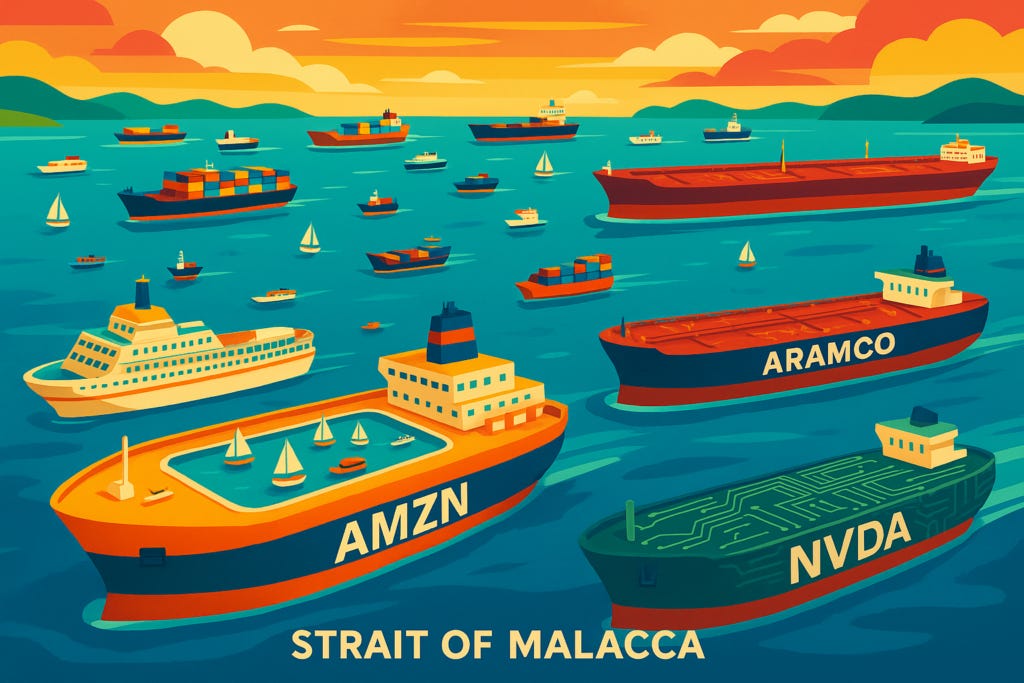
Interestingly, some companies don’t just trade their wares, or even facilitate other trades, but in fact go so far as to generate their own internal markets with their own rules. In the image above, you can see the Amazon ship has a pool on it, with smaller ships inside - this is not inherently a problem, but the analogy helps to clarify what kind of behaviours we might want to be concerned about. Are there other “market ships” that the small ships could move to? How easy is it for the small ships to move to a different “market ship”, or even to set forth on the wider ocean on their own? What would happen to the small ships if the “market ship” sank?
Amazon offers some great benefits to small companies, which help them become established. If enough commerce goes through a single point of failure though, this becomes very risky for the economy, and also puts a lot of power into the hands of these market-place companies that would ordinarily be held by courts and other governmental organs. A large enough “proprietary ocean”, enacting its own rules, is a threat to the government’s market regulation capability.
2.3 Coordination Problems and the Role of Enforcement
Markets are powerful optimisation engines, but they do not always optimise for what matters most. Capitalism optimises for profit; the free market, for low prices. Despite often appearing to align well with humanity’s ultimate goals, neither is actually optimising for human well-being, fairness, sustainability, or our long-term collective interest. When the incentives that drive individual market actors are misaligned with broader societal goals, systemic problems can arise; not out of malice, but through the predictable logic of uncoordinated self-interest.
Coordination problems are a key class of such failures. These are not simply situations where people need to work together, as entrepreneurs often facilitate, but where everyone must change their behaviour simultaneously to achieve a better outcome. In such cases, any individual acting alone would suffer a penalty, even though universal action would bring shared benefit. For example, a firm might hesitate to reduce pollution, or improve safety standards unless all competitors do the same. Markets offer no natural way to make such changes happen in lockstep. There is always an incentive to defect - to reap the benefits of others’ sacrifice without making one’s own.
This is where governments, with their capacity to enforce coordinated change, come into their own. Through regulation and legislation, governments can mandate that everyone moves at once, eliminating the first-mover disadvantage and unlocking the better equilibrium. Environmental rules, labour laws, and safety standards often serve precisely this function: requiring every actor to meet the same baseline at the same time. It is enforcement, not just persuasion or innovation, that makes coordination possible at scale.
Even entrepreneurial solutions to coordination problems usually depend on enforcement mechanisms backed by the state. Kickstarter, for example, is a brilliant solution to the coordination problem of when to commit funds to develop a new product. It facilitates people committing funds such that they only become payable when a certain baseline of financial viability is reached. This pre-commitment only works however, because the law guarantees that the platform must handle those funds transparently and securely. Most real-world coordination requires even more direct enforcement, especially where the stakes are high, the timelines are long, or the costs are borne through action rather than money. In such cases, only the government has the legitimacy and coercive power to enforce fair rules without enabling abuse.
Systemic inefficiencies can also stem from uncoordinated action. Take Braess’s Paradox in traffic planning: adding a new road, while seemingly beneficial, can actually increase overall congestion when individuals each pursue their shortest route independently. Such counterintuitive outcomes are beyond the market’s capacity to self-correct. With centralized oversight however, governments are sometimes able to design infrastructure or modify other complex systems in a way that prioritises collective outcomes over individual gain.
The difficulty with coordination also becomes clear when examining the slow erosion of consumer experience in markets dominated by large platforms. Cory Doctorow’s concept of “enshittification” describes how once-beloved services degrade over time: first serving users, providing a great service as they jockey for market share; then once network effects have entrenched them in a winner-takes-all position, they turn to revenue maximisation, often serving advertisers at the expense of the users, and killing “quality of life” functionality to improve the bottom line for their shareholders. Because most users cannot coordinate an exit, market pressure fails to punish bad behaviour. Only regulatory oversight can enforce minimum standards, transparency, or portability, restoring competition and preventing monopolies from exploiting their customers. Paul O’Brien of the blog Startup Economist has written about the possibility of start-ups resolving this situation, which would be great to see, but I don’t think the incentives are actually aligned with solving the problem. Any start-up that attempted to do so would find itself beholden to the exact same forces that caused the problem in the first place - providing a better product is more expensive, and it is simply more profitable to exploit your customers instead. The author’s main example of the Alamo Drafthouse is in fact a demonstration of this point - it was a start-up that bucked the trend, providing a better customer experience. It got sold, and its founders presumably made a tidy profit, but it is now indistinguishable from all of the other companies in that market.
History offers many examples where enforcement, not voluntary action, proved essential to overcoming entrenched resistance. Dr. Harvey Washington Wiley’s campaign for food safety in the early 20th century illustrates this vividly. Despite clear evidence of dangerous additives and contamination in the food supply, reform was fiercely opposed by industry, and companies that attempted to improve quality were not profitable enough to survive. Wiley’s efforts led to the Pure Food and Drug Act, but only after years of political struggle and public pressure.
Situations like these have a lot in common with the classic prisoners dilemma in game theory. In both cases, it is the power of enforcement that makes the preferred outcome attainable through coordination. Markets may offer efficiency, but governments are still needed to coordinate progress out of these non-optimal equilibria.
3. Toward a Synthesis: Better Markets, Better Government
The debate between markets and governments is often framed as a binary - more freedom versus more regulation, but this framing misses the point. The real objective should be to improve both. Markets are unparalleled at allocating resources, driving innovation, and optimising for efficiency. But they are not perfect. They can fail, especially in the face of unpriced externalities, public goods, and coordination problems. Governments, in contrast, have the tools to address these failures, but only if they wield them competently, with precision and humility.
Governments should see their role as shaping the rules of the game so that individual incentives are aligned with societal outcomes. This includes correcting market failures, adjusting perverse game-theory equilibria, and using tools like taxation and regulation to promote behaviour that benefits society as a whole. Any intervention must be designed with care however, as over-regulation and over-taxation can stifle competition, raise barriers to entry, and lock in inefficiencies. The challenge is to find the minimum necessary intervention to keep the economy working for the benefit of all.
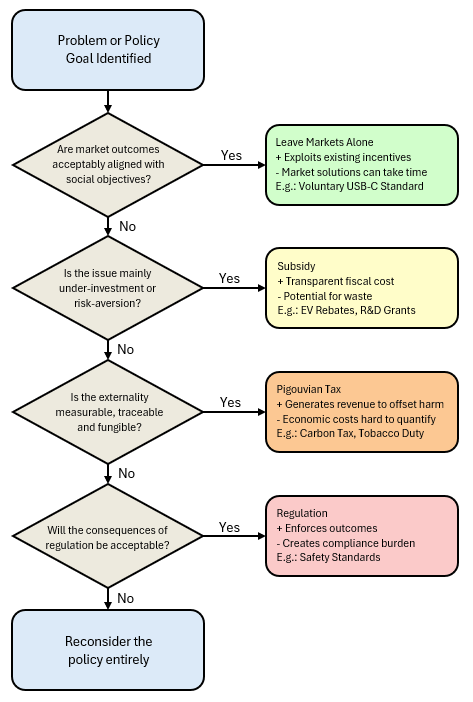
A hierarchy of tools can help guide this balancing act. The lightest touch is simply to let the market work - often the best option. When that fails, using a subsidy can promote desired behaviour by reducing costs and risk for companies and individuals. Subsidies cost money of course, but as interventions go, this is one of their strengths - transparency. Unlike other interventions whose costs might be hidden and hard to assess, the cost of subsidies is easy to see and easy to control. This also generates an incentive to evaluate whether the benefits are worth the expense.
Pigouvian taxes, used to discourage harmful behaviours like pollution or smoking, are a step heavier. They’re effective when the harm is localised and the behaviour relatively easy to track, but because they impose costs without providing clear benefits to any specific actor, their economic burden can be hard to quantify and politically fraught. Worse still, when the harm caused by the taxes is diffuse, such as with tariffs, the unintended consequences can ripple invisibly through the economy, and there is little incentive to expend the necessary effort to quantify the cost. That is not to say that tariffs can never be justified, only that the costs and benefits must be considered very carefully, without wishful thinking. Still, when there is a tax, you can still decide to pay it, if it is sufficiently financially advantageous to do so. While taxes might hinder investment and innovation, a sufficiently revolutionary product is likely to make it to market eventually, as the costs will be worthwhile.
“Experts broadly agree that a good way to tackle many problems is “tax the externality, use the revenue to offset other more distortionary taxes, and ease up on inefficient regulatory solutions.” Voters hate this, for whatever reason.” - Matthew Yglesias
Regulation, the heaviest tool, should be reserved for cases where neither subsidies nor taxes can reliably achieve the desired outcome. This is often the case in matters of safety, where allowing bad actors to “pay to play” is unacceptable. Even good regulations have costs though, slowing innovation and creating compliance burdens that only large firms can afford.
Consider the USB-C standard: a government could decide to take no action to enforce standards, risking consumer frustration in the hope that there are enough intrinsic incentives to provide compatible devices. This is a perfectly viable option, but if a government were determined to try to encourage the standard, which option would be best? An outright ban on alternatives could stifle innovation, which would be very counterproductive, and a subsidy might be wasteful, giving money to companies that would use it anyway (or worse, would add ports to things that didn’t need them). Levying a modest tax on non-standard connectors would be a viable intervention, providing firms with an additional nudge toward compatibility, while allowing exceptions, so that genuinely innovative improvements could still be realised.
Taxation itself should be viewed as a tool not just for revenue, but for steering the economy wisely. For instance, rather than taxing labour or investment, both of which discourage productivity, governments can tax consumption, pollution, or unearned windfalls. A standout example is the Land Value Tax (LVT), which targets the unimproved value of land. Unlike most taxes, an LVT creates no deadweight loss, because land is inherently inelastic in supply. It discourages speculation and hoarding, curbs rent-seeking, and aligns public incentives with increasing housing supply. As land becomes more useful, through infrastructure, planning, or growth, it becomes more valuable and more taxable. The result is a feedback loop in which governments are rewarded for enabling development rather than obstructing it. Some worry that local authorities may misuse their powers: there are plenty of examples of housing associations imposing burdensome or arbitrary rules. This is not an argument against government per se; rather, it highlights the value of decentralised competition. Poorly governed areas will stagnate while more functional regions thrive.
Conclusion
Free markets are among the most powerful tools humanity has devised. Unfortunately, it is too much to ask that they be entirely self-sufficient as well. In the real world, marked by subtle externalities, coordination problems, information asymmetries, and entrenched power; markets left entirely to their own devices do not always deliver outcomes that are efficient, fair, or socially desirable. Just as a machine needs maintenance to function at its best, markets need thoughtful, well-calibrated regulation to preserve competition, protect the vulnerable, and avoid stagnation or collapse. We must value both efficiency and antifragility, designing systems that deliver gains while withstanding shocks and adapting to change.
This is not an argument for heavy-handed interference or blanket suspicion of capitalism. Rather, that we should guard against it being a victim of its own success. As productivity increases and global trade expands, society as a whole may grow richer, yet some individuals may find themselves worse off. If enough people are left behind, the very legitimacy of the system is called into question. Regulations, then, are not merely constraints - they are the mechanisms by which we realign incentives to correct market failures and ensure that rising tides truly lift all boats.
The challenge is not to choose between the market or government regulation, but to insist on better versions of both. Better markets that compete fairly, innovate freely, and align with the long term flourishing of humanity. Better governments that judiciously impose the minimum necessary intervention, while avoiding capture or paternalism. The tension between government and market is not a zero-sum game - a well-regulated market is not only more fair and less predatory, but more stable, more innovative, and more resilient. We are not going to attain this nirvana easily, but it helps to know which direction we need to move in.
Postscript
Shortly after writing this, I read Paul de Grauwe’s book “The Limits of the Market”. A quick read, clocking in at between 4 and 5 times the length of this essay, discussing almost exactly the same thing, and being written by a renowned economist, I would strongly recommend it to anyone that made it this far. Below is a very short summary of what I perceive to be the key points of his book:
Markets are not self-stabilizing, and struggle to internalise long-term costs
De Grauwe challenges the classical liberal notion that markets naturally find equilibrium. He draws on the experience of financial crises (especially 2008) to argue that markets are prone to booms and busts, driven by herd behaviour, speculation, and short-termism. Without regulation, they can spiral into instability.
He argues that the short-termism of markets is inherent. They excel at allocating resources efficiently in the present, but they’re poorly equipped to handle costs or consequences that appear in the distant future. This is especially true for:
Environmental damage (like climate change), where the costs fall on future generations.
Infrastructure underinvestment, because markets under-provide goods with long-term payoffs.
Public health and education, which generate social returns beyond what markets can capture in prices.
The problem is that market prices don’t reflect future social costs - they are “externalities” that are ignored unless regulation forces them into the system. Without intervention, we get overconsumption of harmful goods (like fossil fuels) and underinvestment in beneficial ones.
He introduces the idea that markets have a built-in tendency toward self-destruction when left entirely unregulated. As success accumulates, so do excesses: inequality widens, environmental degradation accelerates, and financial systems take on unsustainable risks. Eventually, the very trust and social fabric markets depend on begin to erode.
The state’s role is to create regulation that is a framework, not a stranglehold
De Grauwe sees the state as a necessary corrective mechanism. Governments are needed to:
Enforce property rights and the rule of law.
Regulate financial markets to prevent bubbles and crashes.
Redistribute income to preserve social cohesion.
Protect public goods (e.g., the environment, education, health).
But he also warns that the state can overreach, becoming inefficient, corrupt, or authoritarian. So it’s not about choosing one over the other, but finding the right balance. While he sees regulation as essential, De Grauwe is careful to stress that it shouldn’t crush innovation or flexibility. His ideal is a rules-based framework that:
Sets boundaries for acceptable behaviour.
Corrects market failures (like externalities or monopolies).
Promotes stability and trust in the system.
So, regulation should be like the rules of a game - clear, consistent, and enforced, but not so rigid that players can’t move.
The Pendulum between Market and Government
He uses a metaphor: societies swing like a pendulum between too much market freedom and too much state control. Crises and disillusionment with one side often lead to a swing back toward the other. Regulation, then, isn’t a once-and-done fix - it needs constant adjustment, depending on the phase of the pendulum.
Finally, De Grauwe quotes thinkers like Karl Polanyi and Michael Sandel in arguing that not everything should be for sale. Regulation isn’t just about economics; it’s about deciding what we value and where market logic doesn’t belong (e.g., organs, education, justice).